How to Read a Birth Chart for Beginners (Step by Step)
· yourhoroscopereading.com
You just got your birth chart and you are staring at a circle full of symbols, lines, numbers, and strange glyphs. It looks overwhelming. You are not alone. This is the first reaction almost everyone has. The good news is that once someone shows you the logic, it becomes remarkably clear.
This guide will walk you through how to read a birth chart for beginners, one step at a time. You do not need any prior astrology knowledge. By the end, you will be able to look at your own chart and immediately understand the most important parts.
Step 1: Understand What a Birth Chart Actually Is
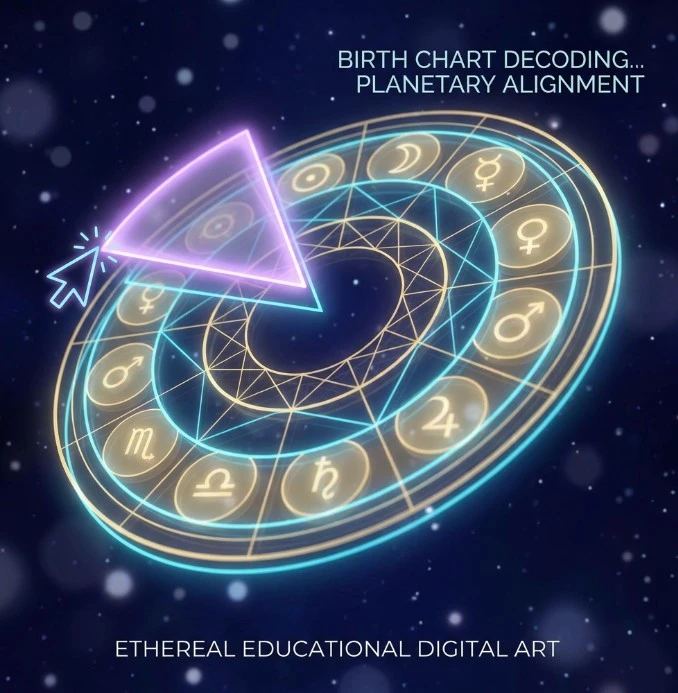
A birth chart, also called a natal chart, is a circular map of the sky at the exact moment and place you were born. Imagine freezing the solar system at the second of your birth and capturing a snapshot. That snapshot gets drawn as a wheel divided into 12 sections. Every planet, the Sun, the Moon, and the Ascendant point all have fixed positions in that wheel, and those positions never change. Your natal chart is permanent.
The outer ring of the wheel shows the 12 zodiac signs in order. The inner sections are the 12 astrological houses. Scattered across the wheel are symbols representing each planet, placed in the zodiac sign and house they occupied at your birth moment. The lines drawn across the center represent aspects, the angular relationships between planets.
That is the whole structure. Signs, houses, planets, and aspects. Once you understand what each layer means, you can read any chart. Always generate your chart first using accurate data. Our free calculator uses NASA JPL precision, so your positions will be accurate to within arc-seconds.
Step 2: Start with Your Big Three (Sun, Moon, Rising)
Do not try to decode everything at once. Start with the three most important placements. These are called the Big Three: your Sun sign, Moon sign, and Rising sign (Ascendant). Together they paint a portrait of who you are more accurately than any single sign can.
Your Sun sign is written as a symbol that looks like a circle with a dot in the center. The sign it sits in on the outer ring is your Sun sign. Your Moon sign uses a crescent symbol. Your Rising sign (Ascendant) is marked by a horizontal line on the left side of the chart wheel, specifically the cusp of the 1st House. The sign on that cusp is your Rising sign.
Take Maya as an example. She pulls up her natal chart and finds her Sun in Leo in the 10th House, her Moon in Pisces in the 5th House, and a Scorpio Rising. Her Sun says she craves recognition and is building toward leadership and public expression. Her Moon says her emotional world is sensitive, dreamy, and creative. Her Rising says she comes across as intense and magnetic to new people. These three alone explain 80% of her most notable personality traits.
Step 3: Learn the 12 Houses and What Each One Rules
The 12 houses divide the birth chart wheel into 12 sections, each ruling a specific area of life. A planet placed in a house brings that planet's energy into that area of life. Here is the simple guide to all 12 houses for birth chart beginners.
House 1 rules identity, physical appearance, and first impressions. House 2 rules money, personal values, and possessions. House 3 rules communication, siblings, local travel, and learning. House 4 rules home, family, roots, and inner security. House 5 rules creativity, romance, children, and joy. House 6 rules health, daily routines, work, and service.
House 7 rules partnerships, marriage, and one-on-one relationships. House 8 rules transformation, shared resources, sexuality, and the occult. House 9 rules travel, education, philosophy, and spirituality. House 10 rules career, reputation, ambition, and public life. House 11 rules friendships, community, hopes, and social causes. House 12 rules the unconscious, hidden things, solitude, and spiritual practice.
Think about it this way. If you find Jupiter (expansion, luck, optimism) placed in your 10th House, it suggests career growth and a tendency to attract recognition. If Saturn (discipline, structure, restriction) sits in your 7th House, partnerships may involve more responsibility, or a tendency to choose serious, long-term commitments over casual ones.
Step 4: How to Read Birth Chart Planets in Signs
Each planet has a natural domain of life it governs. The zodiac sign a planet occupies colors how that planet's energy expresses itself. This is the core language of natal chart interpretation: planet plus sign plus house equals a complete statement about one area of your life.
Mars is the planet of drive, action, and desire. Mars in Aries (its home sign) expresses as direct, fast, competitive energy. Mars in Cancer expresses the same drive but with more defensiveness and emotional motivation. Mars in Capricorn becomes methodical, strategic ambition. Same planet, completely different expression based on sign.
Venus rules love, beauty, and values. Venus in Taurus (another home sign) wants sensory pleasure, physical affection, and stability in love. Venus in Gemini wants stimulating conversation and intellectual connection. Venus in Scorpio craves intense, transformative emotional intimacy. When you understand this pattern, you can decode any planet in any sign quickly.
Here is what most people get wrong: they read generic zodiac descriptions and expect them to apply exactly. Always read the planet in context of both its sign and its house. A Venus in Scorpio in the 11th House behaves differently from a Venus in Scorpio in the 2nd House. The sign describes the quality; the house describes the setting.
Step 5: Understanding Aspects Between Planets
Aspects are the angular relationships between planets. They describe whether two planets are working in harmony, in tension, or in a blended union. Even as a complete beginner, knowing the five main aspects gives you a huge boost in reading your chart.
A conjunction (planets within 0-8 degrees of each other) blends the energies together completely. Often powerful, sometimes overwhelming. A sextile (60 degrees apart) creates easy cooperation and opportunity between the two planet's themes. A square (90 degrees) creates friction, challenges, and the kind of tension that motivates growth. It is not bad. It is the energy that drives you to get better.
A trine (120 degrees) shows natural talent and flow between two planetary energies. Things feel easy there, almost automatic. An opposition (180 degrees) creates a push and pull between two areas of life, a polarity that asks you to find balance between two ends of a spectrum.
James has a Sun conjunct Mercury in his chart. His identity and self-expression (Sun) are deeply fused with communication and thinking (Mercury). He is the person whose thinking is inseparable from who he is. He processes the world through ideas. That one aspect explains his entire conversational style.
Common Mistakes Beginners Make Reading Birth Charts
The most common beginner mistake is trying to read everything at once. A birth chart contains dozens of positions, aspects, and chart points. If you try to synthesize all of it immediately, you get overwhelmed and confused. Start with the Big Three. Spend a week just getting comfortable with those. Then add one placement per week.
Another mistake is treating every placement as a separate isolated fact. Astrology is synthesis. A single placement means very little in isolation. The story emerges from how placements interact. A challenging aspect between two planets is often more important than each planet read alone.
You might be skeptical, and that is completely fine. Many people who come to birth chart interpretation with cynicism find themselves surprised by how uncannily accurate the descriptions feel once they properly understand what each placement means. Read descriptions of your Moon and Rising sign alongside your Sun sign. The combination is almost always more accurate than any single sign alone.
Related Articles
Frequently Asked Questions About Reading Birth Charts
Final Thoughts
Learning how to read a birth chart is one of the most rewarding skills you can develop for self-understanding. You start with the Big Three, then gradually add the houses, the planets in signs, and finally the aspects. Each layer adds depth and nuance. There is no rush. The chart is always there, and it will reveal more to you over time as your knowledge grows. Generate your free birth chart today and start from the very first step: find your Sun, Moon, and Rising sign. Everything else follows from there.
Generate Your Free Birth Chart →