Your Vedic Astrology Chart: A Map to Your Soul's Purpose
· yourhoroscopereading.com
Have you ever felt there is a deeper script to your life, one you are meant to follow? Your Vedic astrology chart holds that script. It is an ancient map, far older than the system you might know, designed to reveal your soul's true journey.
This is not about simple sun sign horoscopes. A Vedic chart, or Jyotish chart, is a complex and precise spiritual tool. It uses the fixed stars of the sidereal zodiac to plot your destiny at the exact moment of your first breath. Think of it as your soul's unique fingerprint in the cosmos.
What is a Vedic Astrology Chart?
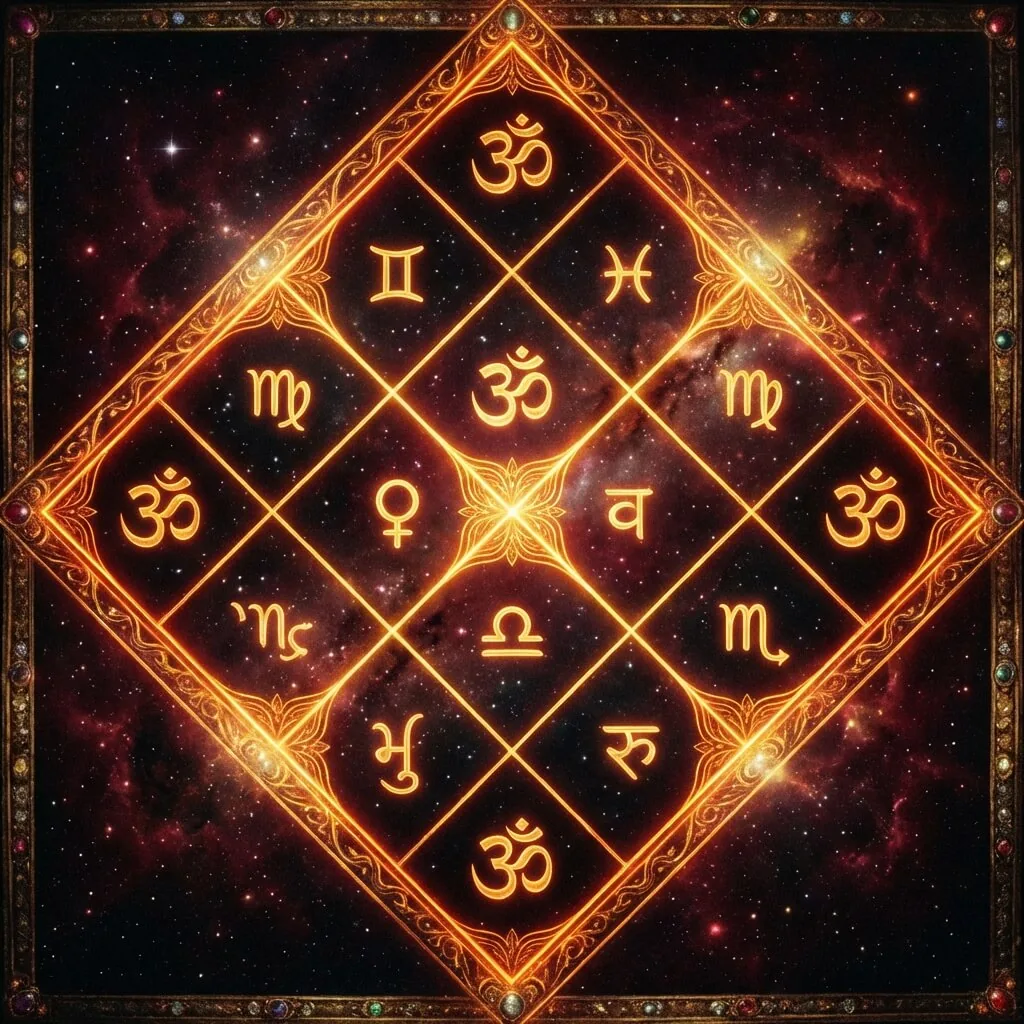
A Vedic astrology chart is a spiritual blueprint. It is called a Janma Kundali in Sanskrit. This chart is a snapshot of the sky at the exact time, date, and place of your birth. But it uses a different system than Western astrology. This difference is the key to its profound accuracy.
The core of Vedic astrology, or Jyotish, is the sidereal zodiac. This zodiac is anchored to the actual, observable constellations in the sky. Western astrology uses the tropical zodiac, which is tied to the seasons. Over thousands of years, these two zodiacs have drifted apart. This drift is called the Ayanamsa. It means your sun sign in Vedic astrology is likely different from your Western one.
Here is what most people get wrong. They think their Western sun sign is their only identity. In Vedic astrology, your rising sign, or Ascendant, is actually more important. It is the sign that was rising on the eastern horizon when you were born. This sign sets up your entire chart and dictates how you present yourself to the world. Your Vedic birth chart reading delves into this first.
Think about it this way. Imagine two people born on the same day. One is born at sunrise in New York. The other is born at sunset in Tokyo. Their sun sign might be similar, but their rising signs will be completely different. Their life experiences and personalities, as shown in their Vedic charts, will be worlds apart. This precision is the power of Jyotish.
The Key Components of Your Vedic Birth Chart
Your Vedic birth chart looks like a geometric wheel divided into twelve houses. Each house governs a specific area of your life. The planets, called Grahas, sit in these houses and in specific signs. Their positions create your unique story. Let us break down the three most critical pieces.
First are the planets. In Vedic astrology, the Sun and Moon are considered planets, along with Mars, Mercury, Jupiter, Venus, Saturn. It also uses two shadow planets, Rahu and Ketu, which are points where the moon's path crosses the sun's. Each planet represents a specific energy. For example, Mars is your drive and courage. Venus is your love and values.
Second are the houses. The first house is you, your body and personality. The second house is wealth and speech. The third is siblings and courage. This goes all the way to the twelfth house of liberation and endings. Where a planet sits tells you *where* its energy will play out. A planet in your seventh house of partnership affects your marriage. The same planet in your tenth house affects your career.
Third are the signs. The twelve signs, from Aries to Pisces, color the energy of the planet and house. Let us use a real named example. Priya has Jupiter, the planet of expansion and luck, in her second house of wealth. That sounds great. But if Jupiter is in Capricorn, a sign where it is considered weak, its blessings may come only after hard work and discipline. The sign modifies the result.
This is where it gets interesting. The chart also shows connections between planets, called aspects. These aspects create a dynamic conversation in your life. A challenging aspect might create an obstacle you are meant to overcome. A beneficial one might show a natural talent. A skilled Vedic astrologer synthesizes all these layers.
Why the Sidereal Zodiac Makes All the Difference
The sidereal zodiac is the non-negotiable foundation of Jyotish astrology. Sidereal means "of the stars." This system aligns your chart with the actual star constellations as we see them in the night sky today. It is a fixed, celestial map.
Western astrology uses the tropical zodiac. Tropical means "of the turn." It is based on the sun's relationship to the Earth's seasons, starting with Aries at the spring equinox. Because of a slow wobble in Earth's rotation, the equinox point slides backward through the constellations over time. This means the seasonal starting point and the stellar starting point no longer match.
Currently, the two zodiacs are about 24 degrees apart. That is almost an entire sign. So, if your Western sun sign is Taurus, there is a high chance your Vedic sun sign is Aries. This shift explains why you might not fully relate to your Western sign description. The sidereal system often feels more accurate because it reflects the real sky.
You might be skeptical, and that is completely fine. Consider this practical test. Look up your Vedic moon sign. The moon represents your emotions and inner world. Read about that sign's emotional nature. Many people find the description of their Vedic moon sign resonates more deeply than their Western sun sign. It clicks. The moon changes signs every 2.5 days, making it a highly personal point. The sidereal calculation simply makes it more precise.
How a Vedic Astrology Chart Affects Your Daily Life
Your Vedic astrology chart is not just for major life predictions. It is a practical guide for daily living. It helps you understand your natural rhythms, your strengths to lean into, and your challenges to navigate wisely. It turns fate into conscious choice.
One major tool is the Dasha system. This is a timeline of planetary periods that you cycle through from birth. You are always under the influence of a specific planet's major period and sub-period. If you are in a Jupiter Dasha, it is a time for growth, learning, and optimism. Knowing this, you can confidently take a course or expand your business. If you are in a Saturn period, it is a time for discipline and hard work. You can buckle down instead of fighting the energy.
Another tool is the analysis of your current transits. This is where an astrologer looks at where the planets are right now and how they interact with your natal chart. For example, when Saturn transits your fourth house of home, you might feel pressure to become more responsible there. Maybe you need to repair your house or provide more stability for your family. Seeing this coming helps you work with the energy, not against it.
Your chart also reveals your innate talents. The fifth house shows creativity and intelligence. A well-placed Mercury there could indicate a gifted writer or teacher. The tenth house shows career. A strong Mars there might point to success in engineering or the military. Understanding this can guide your education and career path, saving years of trial and error.
Common Misconceptions About Vedic Astrology
Many people dismiss Vedic astrology based on misunderstandings. Let us clear up the biggest ones. The first misconception is that it is fatalistic. People think it says your life is set in stone and you have no free will. This is completely wrong. Jyotish is a map, not a prison sentence.
Think about it this way. Your birth chart is like the weather forecast for your life. It tells you there is a 70% chance of rain this afternoon. That is the fate part, the potential. The free will part is you choosing to carry an umbrella. The chart shows your tendencies and likely events, but your awareness and actions shape the outcome. It empowers you to make better choices.
The second big misconception is that it is only about predicting the future. Prediction is one aspect, but the deeper goal is self-knowledge and spiritual growth. A Vedic birth chart reading aims to answer the "why." Why do you have a quick temper? Maybe Mars is in a sensitive house. Why do you struggle with commitment? Perhaps Saturn influences your seventh house. Knowing the "why" brings peace and a path for improvement.
A third misconception is that it is too complex for the average person. While it is a deep science, its core insights are accessible. You do not need to become an astrologer to benefit. Just understanding your rising sign, your moon sign, and your current planetary period can offer incredible clarity. Start with those basics, and the rest can unfold over time.
Related Articles
Frequently Asked Questions
Final Thoughts
Exploring your Vedic astrology chart is a journey into the deepest parts of yourself. It moves beyond simple personality labels into the realm of soul purpose, karmic lessons, and life timing. By embracing the precision of the sidereal zodiac and the wisdom of Jyotish, you gain a powerful tool for navigation. You begin to see your challenges as necessary curriculum and your talents as gifts to be shared. This ancient map does not limit you. It sets you free by revealing why you are here and how you can walk your path with more confidence and grace. Start your exploration today. Let your Vedic birth chart reading illuminate the path you were always meant to walk.
Open Vedic Panchang & Muhurat Tool →